
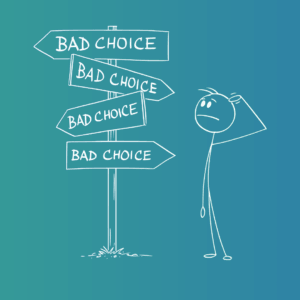
Everyone Makes Them: Here's How to Recover from a Bad Business Decision
Every business owner has made a decision they wish they could take back. It could be launching a product before it was ready, hiring the wrong person, investing in the wrong opportunity or pursuing a strategy that simply didn’t deliver the expected results.
The reality is that making a poor business decision doesn’t make you a poor leader. Even the most successful entrepreneurs and executives have experienced setbacks. What sets effective leaders apart is not avoiding mistakes altogether, but how they respond when things don’t go according to plan.
Bad decisions are more common than you think
Business leaders make difficult decisions every day, often with limited information and under significant pressure. It’s no surprise, then, that many experience uncertainty or regret.
A 2023 study commissioned by Oracle, involving more than 14,000 employees and business leaders across 17 countries, found that 85% of business leaders experienced “decision distress” during the previous year. Many reported questioning decisions they had made, while 72% admitted they had delayed or avoided making decisions altogether because the amount of available data felt overwhelming.
The takeaway is reassuring: making the wrong call occasionally is part of running a business. The real opportunity lies in learning from those experiences.
Take responsibility early
When a decision doesn’t produce the desired outcome, it’s tempting to delay addressing the issue or hope it resolves itself.
However, accountability is one of the most valuable leadership qualities. Acknowledging a mistake early builds trust with employees, clients and stakeholders, while trying to minimise or conceal it often damages credibility far more than the original error.
Owning a mistake also allows you to shift your focus from explaining what happened to finding the best way forward.
Understand what really went wrong
Recovering from a poor decision requires more than identifying the obvious outcome. It’s important to understand the underlying cause.
Ask questions such as:
- Was the decision made with incomplete or inaccurate information?
- Were alternative viewpoints considered?
- Did time pressures influence the outcome?
- Were customer needs or market conditions misunderstood?
- Did internal processes contribute to the mistake?
Leadership consultant and author Denis Liam Murphy refers to this as developing “real-time hindsight”—taking the time to reflect honestly on what happened while the experience is still fresh, rather than waiting until much later.
The deeper the understanding, the more valuable the lesson becomes.
Learn from leaders who turned things around
One of the best-known examples of recovering from a poor strategic direction is Starbucks.
When Howard Schultz returned as CEO in 2008, the company had experienced rapid expansion, declining performance and a weakening of the customer experience that had originally set the brand apart.
Rather than focusing on quick fixes, Schultz returned the business to its core values. Thousands of stores temporarily closed for staff retraining, product quality became a priority once again, and the company slowed its expansion to rebuild a stronger foundation.
The turnaround became a widely studied business success story, demonstrating that lasting recovery comes from addressing root causes rather than treating symptoms.
Turn mistakes into better systems
One of the most valuable outcomes of any setback is the opportunity to improve the way future decisions are made.
After a significant business decision, it can be helpful to review:
- What worked well?
- What didn’t work?
- What information was missing?
- What warning signs were overlooked?
- What changes can prevent similar mistakes in future?
Documenting these lessons and sharing them with your team creates a culture of continuous improvement. Instead of becoming costly setbacks, mistakes become valuable learning opportunities for the entire organisation.
Resilience doesn’t mean ignoring mistakes
Strong leaders don’t pretend mistakes don’t matter.
True resilience means acknowledging disappointment, learning from the experience and moving forward with greater insight.
Research suggests that resilient leaders share several important habits. They view setbacks as opportunities to improve, prioritise their own wellbeing during challenging periods and rely on trusted advisers or colleagues who provide honest feedback when it’s needed most.
Taking time to reflect and recover isn’t a weakness—it’s an investment in making better decisions in the future.
The bottom line
Every successful business has experienced setbacks along the way. What matters most isn’t whether mistakes happen, but how they’re handled.
By accepting responsibility, understanding the real causes, improving decision-making processes and applying the lessons learned, business leaders can turn difficult moments into opportunities for growth.
No decision will ever come with complete certainty. But every decision, whether successful or not, offers an opportunity to become a stronger and more effective leader.
At BGR, we understand that sound financial advice and strategic guidance play an important role in better business decision-making. Whether you’re navigating a challenging period or planning your next stage of growth, our team is here to provide the insight and support your business needs.